
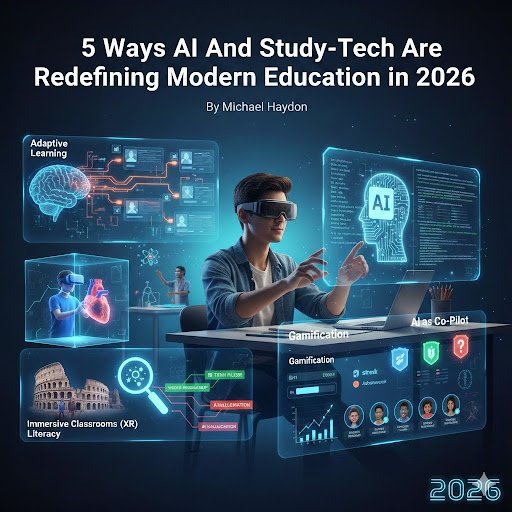
The image of a student huddled over a 1,000-page textbook is quickly becoming a relic. In 2026, the “good student” is no longer defined by rote memorization, but by their ability to navigate a complex digital ecosystem of AI study assistants and adaptive learning platforms.
As an EdTech strategist who has spent the last year analyzing the shift from generative AI to “Agentic” learning, I’ve watched the landscape for high school and college students undergo a seismic shift. Here is how “Study-Tech” is redefining the modern classroom in 2026.
1. Adaptive Learning: The End of the “Average” Student
For decades, the biggest flaw in education was its rigidity—teaching to the “middle” of the class. Today, adaptive learning software has shattered that mold. These systems use machine learning to identify a student’s specific cognitive gaps in real-time.
- The Practical Application: If a high school senior struggles with the chain rule in calculus but understands basic derivatives, the software pivots, offering targeted micro-lessons.
- The Result: This “Hyper-Personalization” ensures students are never bored by what they know or paralyzed by what they don’t.
2. AI as a Co-Pilot: Moving Beyond the “Cheating” Narrative
There is a common misconception that AI tools for students are simply “shortcuts.” In 2026, the most successful students use AI as a sophisticated co-pilot to manage the cognitive load of higher education:
Deep Research Synthesis:
Using tools like Perplexity or Humata to find peer-reviewed sources and summarize 50-page academic papers into digestible briefings.
STEM Debugging:
Engineering students now use AI to spot logic errors in Python or Java, allowing them to focus on architecture rather than syntax. Those needing deeper insights often seek programming assignment help to refine their coding frameworks.
Strategic Outlining:
Generating complex logical frameworks for thesis papers before the writing process begins.
While AI provides the framework, the demand for human-led academic expertise has actually increased. To bridge the gap between an AI-generated draft and scholarly excellence, many students utilize Myassignmenthelp.com for human-verified academic oversight. This hybrid approach ensures that the “human element” remains at the core of the final submission.
3. Gamification: Turning Academic “Grit” into Engagement
Developers have finally mastered student engagement by integrating gamified learning. Platforms like Quizlet and Duolingo have evolved; by using “streaks,” “global leaderboards,” and instant feedback loops, they tap into the brain’s dopamine pathways. This shift has transformed student productivity from a chore into a rewarding quest, helping high schoolers build “grit”—the ability to persist through difficult academic tasks via micro-rewards.
4. Immersive Classrooms: The Rise of XR (Extended Reality)
We have moved past 2D instructional videos. In 2026, XR in the classroom means the walls are no longer a limit:
- Medical Students perform virtual surgeries on high-fidelity 3D anatomical models.
- History Students participate in VR “field trips” to ancient civilizations, experiencing the scale of the Roman Colosseum firsthand.
- Chemistry Students manipulate atoms in a virtual lab, conducting experiments that would be too dangerous or expensive in a physical setting.
5. Information Literacy: The “New” Digital Survival Skill
With the abundance of information comes a new challenge: Information Literacy. In the age of generative AI, students must learn how to vet sources and identify “AI hallucinations.” Teaching students how to verify the truth—distinguishing between a hallucinated citation and a peer-reviewed fact—is now the most important subject taught in American high schools.
Frequently Asked Questions
Q.1 Is using AI for school assignments considered cheating in 2026?
It depends on the institution’s “Use Policy.” While using AI to write a final essay is academic misconduct, using AI study tools for brainstorming, outlining, or explaining complex concepts is widely accepted as a legitimate study aid.
Q.2 How can I tell if an AI-generated fact is an “hallucination”?
Apply the “Rule of Three”: cross-reference any AI-generated claim with at least two credible, human-authored sources, such as academic journals or reputable news outlets.
Q.3 What are the best AI study tools for high school students 2026?
The top-rated tools currently include Khan Academy (Khanmigo) for Math/Science, Notion AI for organization, and Anki for spaced repetition. For complex projects requiring expert human feedback, MyAssignmentHelp remains a premier resource for academic coaching.
Q.4 Does VR actually improve student grades?
Yes. Research indicates that “active participation” in VR environments can increase long-term information retention by up to 75% compared to passive reading or watching videos.
Q.5 How do I cite AI in my bibliography?
Most major style guides (MLA 9th Edition, APA 7th, and Chicago) have specific formats for generative AI. Always include the prompt used and the date of access to maintain full transparency.
About the Author: Michael Haydon is a senior EdTech strategist and contributor at MyAssignmentHelp.com. With over a decade of experience in academic consulting, he specializes in the intersection of AI-driven learning and student performance across the USA.