
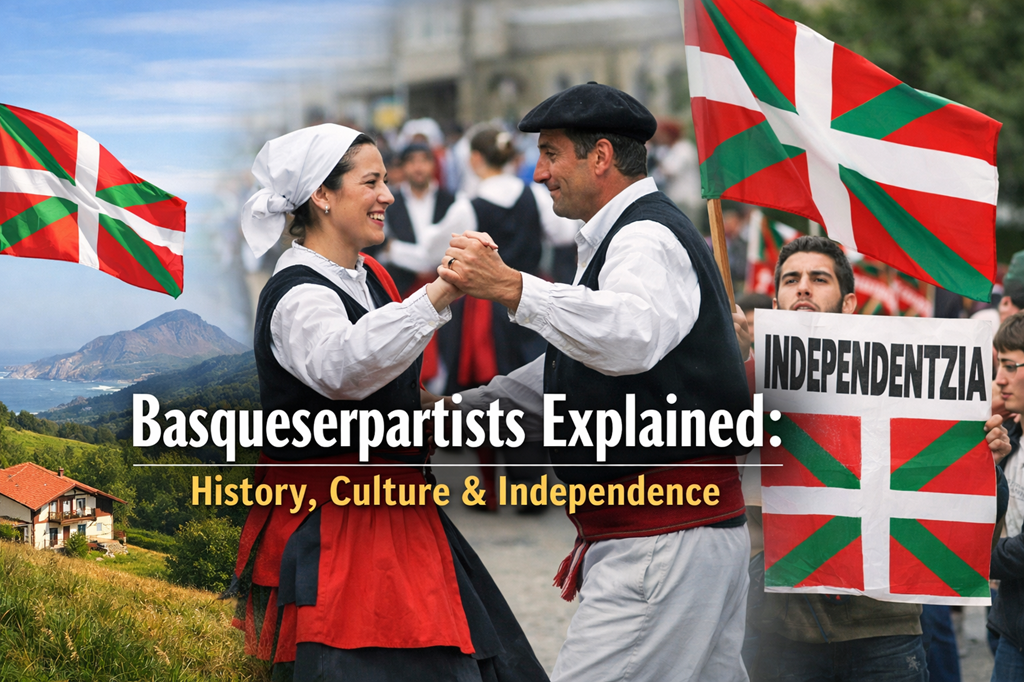
Basqueserpartists is a modern, web-driven term most commonly used to describe people, groups, and movements that support Basque self-determination or full political independence for the Basque homeland. While the spelling varies online, the intent is consistent. It points to a long-standing political and cultural movement rooted in identity, history, and the desire for self-rule.
This article breaks down the meaning of Basqueserpartists by exploring its historical roots, cultural significance, political ideas, and how the movement is understood today.
What Does Basqueserpartists Mean?
Basqueserpartists refers to individuals or organizations that believe the Basque people form a distinct nation and should have the right to govern themselves independently from existing states.
In practice, the term includes:
-
Supporters of full independence
-
Advocates of expanded autonomy and self-government
-
Cultural activists who defend Basque language and heritage
-
Political parties that promote the right to decide
Although the word itself is informal and not academic, it is widely used online to describe the broader Basque separatist conversation.
Who Are the Basque People?
To understand Basqueserpartists, it is essential to understand the Basque people first.
The Basque people live in a region spanning northern Spain and southwestern France, commonly known as the Basque Country. This region has preserved a strong local identity for centuries, even as modern national borders formed around it.
What makes the Basque people unique is not only geography, but also language, customs, and historical continuity.
One of the strongest foundations of Basqueserpartists ideology is language.
The Basque language, known as Euskara, is considered one of the oldest living languages in Europe and has no known linguistic relatives. Because it is not derived from Latin or Indo-European roots, it stands apart from Spanish and French.
As a result, language preservation is not symbolic. Instead, it is practical and emotional. Many supporters believe that without political control, long-term language survival becomes harder.
Therefore, education, media, and daily use of Euskara remain central to Basque self-determination efforts.
Historical Background of Basqueserpartists
Early Autonomy and Local Rights
Historically, Basque territories maintained local governing traditions and legal customs. Over time, centralized state systems reduced these regional powers. As a result, many Basque communities felt their identity and autonomy weakening.
Modern Nation-States and Cultural Pressure
As Spain and France consolidated modern national identities, the Basque region experienced increasing pressure to conform. During certain periods, especially in the 20th century, Basque language and cultural expression were restricted.
Because of this, political awareness grew steadily rather than suddenly.
The Emergence of Organized Movements
By the mid-20th century, Basque nationalism became more structured. While some groups chose peaceful political participation, others turned toward armed struggle, creating deep divisions that still influence public memory today.
ETA and the Impact of Political Violence
No serious discussion of Basqueserpartists can ignore the role of ETA.
ETA was an armed organization that claimed to fight for Basque independence using violent methods. Over several decades, its actions caused loss of life, fear, and political tension. Because of this history, the Basque independence movement became closely associated with conflict in the public eye.
However, it is important to be precise.
-
ETA ended armed activity years ago
-
The organization formally dissolved in 2018
-
Modern Basque politics largely reject violence
Today, most Basqueserpartists explicitly support peaceful, democratic processes. Therefore, current movements should not be defined only by past actions.
Political Goals of Basqueserpartists Today
Basqueserpartists do not all want the same outcome. Instead, their goals exist on a spectrum.
Common Political Objectives
-
Greater control over local governance
-
Protection of cultural and linguistic rights
-
Recognition of the Basque people as a nation
-
The democratic right to choose political status
Some supporters seek full independence, while others focus on enhanced autonomy within existing states.
Because opinions differ, modern Basque politics is shaped more by negotiation than confrontation.
Basque Autonomy and Self-Government
A common misunderstanding is that the Basque region lacks political power. In reality, the Basque Autonomous Community holds one of the strongest self-governing frameworks in Europe.
Key areas of responsibility include:
-
Education and cultural policy
-
Healthcare administration
-
Local policing
-
Regional economic management
Because of this, many Basqueserpartists focus on protecting and expanding autonomy, not replacing it overnight.
Culture at the Center of the Movement
Culture remains a unifying force within the Basqueserpartists conversation.
Cultural Elements That Matter Most
-
Traditional music and dance
-
Local festivals and rural sports
-
Cuisine and family traditions
-
Storytelling and oral history
For many supporters, independence is not an abstract political idea. Instead, it is a way to ensure that future generations inherit a living culture, not a museum version of it.
Therefore, cultural preservation often motivates action more than ideology.
Basqueserpartists in Modern Society
Today, Basqueserpartists are active through:
-
Democratic political parties
-
Civil society organizations
-
Language advocacy groups
-
Education and youth programs
At the same time, younger generations tend to frame identity in more open and inclusive ways. As a result, modern Basque nationalism often emphasizes dialogue, social policy, and cultural confidence rather than confrontation.
Social media and global communication have also reshaped how the movement is discussed and understood worldwide.
Common Misunderstandings About Basqueserpartists
Misunderstanding 1: All Basques support independence
This is false. Opinions vary widely across regions, age groups, and social backgrounds.
Misunderstanding 2: The movement is violent
While violence exists in the historical record, modern Basqueserpartists overwhelmingly support peaceful methods.
Misunderstanding 3: Culture is secondary to politics
In reality, culture is often the primary motivation, with politics serving as a protective tool.
The Future of Basqueserpartists
The future of Basqueserpartists will likely depend on:
-
Democratic participation
-
Legal frameworks and dialogue
-
Cultural resilience
-
Education and generational continuity
Rather than dramatic rupture, change is more likely to occur gradually through negotiation, policy reform, and cultural confidence.
Even if political independence never occurs, Basque identity remains strong, adaptive, and deeply rooted.
Frequently Asked Questions
What does Basqueserpartists mean in simple terms?
It refers to people who support Basque self-rule or independence based on identity, culture, and history.
Are Basqueserpartists active today?
Yes. They participate mainly through politics, education, and cultural initiatives.
Is the movement peaceful now?
Yes. Modern Basque movements focus on democratic and legal approaches.
Is language really that important?
Yes. Euskara is central to Basque identity and long-term cultural survival.
Final Thoughts
Basqueserpartists is not just a political label. It reflects a broader human story about identity, belonging, and self-expression.
At its core, the movement asks a simple question: Who gets to decide the future of a people with a unique history and culture?
Understanding Basqueserpartists requires patience, nuance, and respect for complexity. When explained clearly, it becomes less about division and more about the universal desire to protect heritage, dignity, and choice.