
If you own property in the Lone Star State, you already know the ground here has a mind of its own. While the sunsets are breathtaking and the wide-open spaces are legendary, the soil—or rather, the lack of it—can be a developer’s nightmare. In many parts of Texas, you don’t dig a hole; you chip away at a solid shelf of limestone.
For years, landowners faced a brutal choice when prepping a site: bring in heavy excavators to rip up the rock, load it into dump trucks, and pay hefty fees to haul it away. Then, to add insult to injury, they had to pay again to bring in fill dirt or road base to make the land usable. It was a cycle of inefficiency that drained budgets and extended timelines.
But the industry has evolved. At Texas Land Clearing Solutions, we advocate for a method that works with the land rather than fighting a losing battle against geology. It’s called rock milling, and it is changing the way Texans look at their rocky terrain.
The Geology of the Problem
Before understanding the solution, we have to respect the obstacle. Much of Texas, particularly the Hill Country and western regions, sits atop massive formations of limestone and caliche. When you look out at a pasture and see “floating rocks”—boulders just breaking the surface—it’s usually just the tip of the iceberg.
Traditional bulldozing often creates more problems than it solves. Ripping up these rocks leaves gaping craters that need to be filled. The extracted boulders are often too large to be buried, leading to massive spoil piles that become eyesores and habitats for unwanted pests.
This is where the specialized machinery of rock milling steps in. Instead of treating the rock as trash to be removed, we treat it as raw material waiting to be processed.
Turning Obstacles into Assets
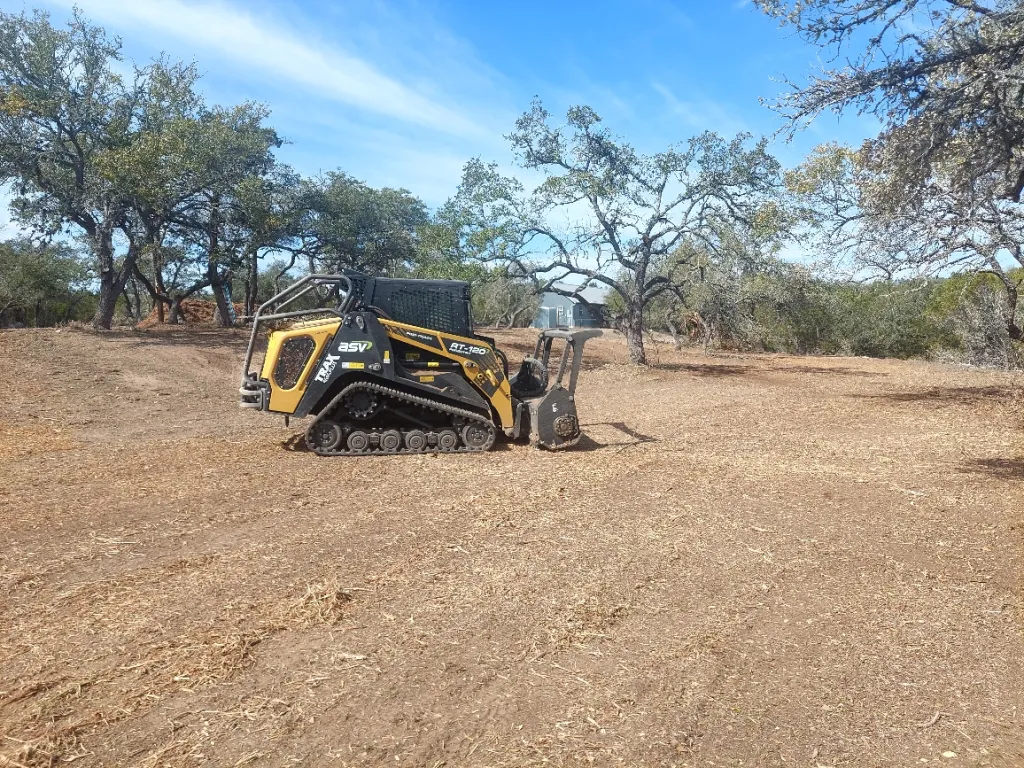
Rock milling is exactly what it sounds like, but the results are often surprising to those who haven’t seen it in action. We utilize heavy-duty, specialized attachments capable of grinding solid rock into gravel and dust right where it lies.
This process transforms the very thing standing in your way into a valuable asset. The “trash” rock becomes usable material. Here is why this shift in perspective is saving landowners thousands of dollars.
Creating Your Own Road Base
One of the most immediate applications for rock milling is infrastructure. If you are building a ranch road, a long driveway, or a pad for a new barn, you need a stable base. Usually, this involves buying loads of crushed granite or caliche and paying for delivery.
With rock milling, we can grind the existing rock in the proposed path. The machine crushes the limestone into a fine, compactable aggregate. Essentially, you are manufacturing your own road base on-site, free of charge. You eliminate the trucking costs for material removal and the trucking costs for material import.
Pasture Reclamation and Soil Health
It might seem counterintuitive that crushing rocks helps grass grow, but in Texas, it makes perfect sense. Large, solid rock sheets prevent water absorption. Rain hits the limestone and runs off immediately, taking precious topsoil with it.
When Texas Land Clearing Solutions mills the surface rock, we fracture that impermeable layer. The rock is reduced to a mulch-like consistency that mixes with the existing soil. This does two things:
- Water Retention: The crushed rock creates a porous layer that holds moisture far better than solid stone or hard-packed clay.
- Root Access: Native grasses can finally push roots deep into the ground, rather than skirting across the surface of a rock shelf.
The result is a pasture that stays greener longer and supports more livestock or wildlife.
The Myth of the “Clean Slate”
A common misconception in land development is the idea of the “clean slate”—stripping a property down to bare dirt to start over. In reality, stripping land is often an invitation for aggressive erosion.
Rock milling offers a less invasive alternative to the “scrape and burn” method. Because the machinery is precise, we can mill around desirable trees (like those iconic Live Oaks) without damaging their root systems, which often extend horizontally through rock fissures.
Instead of leaving a scarred, bare surface that washes away in the next thunderstorm, rock milling leaves behind a layer of crushed material that acts as an armor against erosion. It stabilizes the ground immediately, allowing you to drive over it, build on it, or seed it without waiting for the ground to settle.
Efficiency is King
Time is the one resource you can’t buy more of. Conventional excavation is slow. It involves a coordinated dance of excavators, loaders, and dump trucks. If one link in that chain breaks—a truck gets a flat, or the dump site closes early—the whole project stalls.
Rock milling is a single-phase operation. Our machines move across the land, processing the material in a single pass. There is no waiting for trucks. There are no landfill fees. There is no downtime waiting for imported materials.
For commercial developers and residential owners alike, this speed means moving to the construction or planting phase weeks, sometimes months, ahead of schedule.
Common Myths About Rock Milling
Since this technology is a specialized service, we often hear a few misconceptions from clients before they hire Texas Land Clearing Solutions. Let’s clear the air.
“Is it only for massive boulders?”
Not at all. While the machines can handle large rocks, rock milling is excellent for “bony” ground—fields scattered with fist-sized to basketball-sized rocks that wreak havoc on mowers and tractors. Milling smooths out these rough pastures, turning an equipment-breaking field into a mowable lawn.
“Will it leave sharp jagged edges?”
The goal of milling is a usable surface. The heavy drum of the miller spins at high speeds with carbide teeth, pulverizing the stone. The result is typically a mix of dust and gravel, smooth enough to drive a standard pickup truck over without worrying about your tires.
“Is it bad for the environment?”
It is actually one of the most environmentally friendly ways to clear land. By eliminating the need for haul-off trucks, we drastically reduce the carbon footprint of the project. Furthermore, because we aren’t importing foreign soil, we aren’t introducing invasive plant species or foreign pests to your property.
The Texas Land Clearing Solutions Difference
Not all machines—and not all operators—are created equal. Rock milling requires a deft touch. Go too deep, and you are wasting fuel and time. Go too shallow, and you leave dangerous nubs that can damage vehicles later.
At Texas Land Clearing Solutions, we understand the specific geological challenges of this region. We don’t just run the machine over the ground; we analyze the topography. We look at water flow, soil composition, and your ultimate goals for the property.
Whether you are prepping a site for a custom home foundation, clearing a right-of-way for utilities, or simply trying to reclaim a pasture that has become too rough to use, rock milling provides a solution that is permanent and cost-effective.
Stop Fighting the Land
Rock milling turns stubborn stone into a workable foundation instead of an expensive obstacle. In Texas, the saying holds—you can pay to move the rock, or you can crush it and build directly on what’s already there.
Your land has potential buried just beneath the surface. Don’t let the rugged terrain dictate what you can and cannot do with your property. By choosing rock milling, you are choosing efficiency, sustainability, and a smarter way to work.
If you are staring at a rocky landscape and wondering where to begin, let us turn that stone into a stepping stone for your next big project.