
The mobile app ecosystem is a battlefield worth billions of dollars. With millions of apps competing for attention in the App Store and Google Play, simply having a great product is not enough on its own. Success hinges on effective marketing. But how do you know which marketing efforts are actually working? You might spend thousands on Meta ads, Google campaigns, and TikTok influencer spots, but which specific ad or network delivered that valuable new user? This is the central question that attribution answers.
In its simplest form, mobile app attribution is the science of connecting a new app install back to the specific marketing touchpoint that drove it. It’s a digital detective story. The process meticulously tracks the user path from click to install attribution, creating a clear line of sight between advertising efforts and growth. This information is the fundamental driver of scalable and profitable app growth.
This article explores the mechanics of mobile app attribution, detailing how a simple click on a banner ad transforms into a trackable, analyzable install, and why this process is becoming more challenging and more critical than ever.
Why Mobile App Attribution Matters
Without attribution, your marketing budget is a black box. You know money goes in and installs come out, but you cannot identify which channels are profitable and which are draining your resources.
Effective attribution allows you to:
- Optimize Ad Spend: You can confidently invest more in high-performing campaigns and stop wasting money on low-performing ones.
- Understand User Value: Discover which channels bring in users who not only install but also make in-app purchases or engage long-term.
- Refine Creatives: Test which ad copy, images, or videos resonate most with your target audience and lead to action.
The Mechanics: Tracing the Digital Footsteps
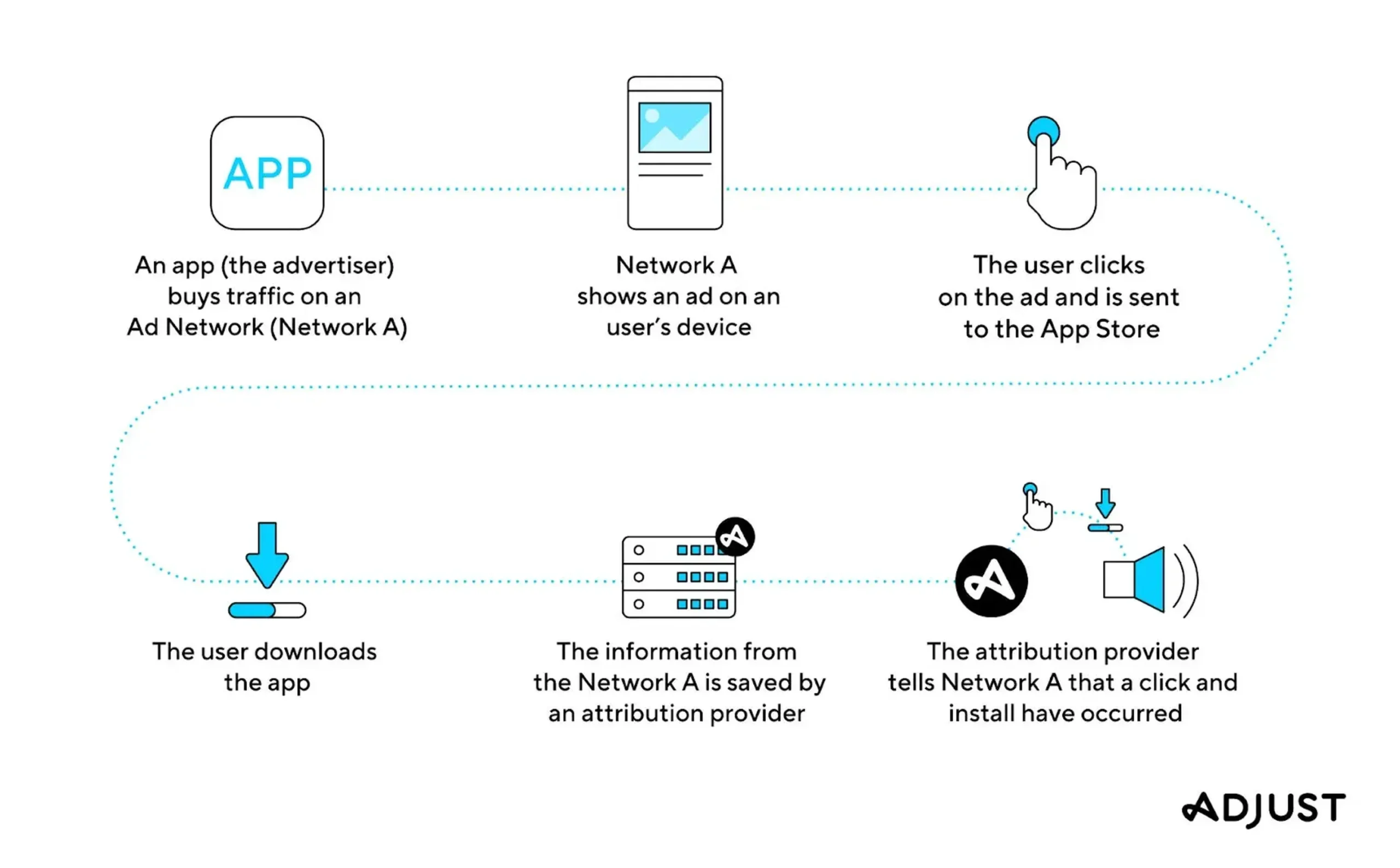
So, how does an attribution platform technically connect a click to an install that might happen minutes or even hours later? The process involves several key components working in perfect sync.
Step 1: The Click (Capturing Intent)
The journey begins when a user interacts with an ad. When you set up an ad campaign, you do not use a direct link to the App Store. Instead, you use a special tracking link or attribution link provided by a Mobile Measurement Partner (MMP) or the ad network itself.
When a user clicks this link:
- They are momentarily redirected through the attribution provider’s server before being sent to the App Store.
- In that split second, the server captures crucial data about the click. This includes the ad network, campaign name, ad creative, and a unique identifier for the user’s device (more on this later).
- A “timestamp” is recorded. The clock has started.
Step 2: The Install (The First Open)
The user lands on the App Store, downloads the app, and, in a crucial moment, opens it for the first time.
A download is not an install. The attribution process is only initiated when the app is first launched. Embedded within the app’s code is a small piece of software called a Software Development Kit (SDK) from the attribution provider.
When the app is opened, this SDK “wakes up” and communicates with the same attribution server that logged the click.
Step 3: The Match (Connecting the Dots)
This is where the connection happens. The SDK has data from the “install,” and the server has a database of all recent “clicks.” The attribution provider’s job is to find a match. This is achieved through two primary methods.
Deterministic Attribution (The “Perfect Match”)
This method relies on unique device identifiers that are publicly available.
- On iOS (historically): The IDFA (Identifier for Advertisers).
- On Android: The GAID (Google Advertising ID).
The process is 1:1 and highly accurate:
- Click: The tracking link captures the user’s IDFA or GAID.
- Install: The SDK (on first open) reads the same IDFA or GAID from the device.
- Match: The server sees “Device ABC” clicked a Meta ad at 10:00 AM and “Device ABC” installed the app at 10:05 AM. It’s a confirmed match. Credit is given to the Meta ad.
Probabilistic Attribution (The “Educated Guess”)
What happens if a device identifier isn’t available? This is increasingly common. In this case, attribution providers use a “probabilistic” model, also known as fingerprinting.
This method creates a temporary “fingerprint” of the device at the time of the click by gathering a cluster of non-unique data points:
- IP Address
- Device Model (e.g., “iPhone 14 Pro”)
- Operating System (e.g., “iOS 17.1”)
- Carrier
- Language
When the SDK activates on first open, it gathers the same set of data. The server then looks for a match within a short time window (e.g., the last 1-2 hours). If a click and an install share the same “fingerprint” and occurred close together, the system makes a match with high probability.
The New Battlefield: Attribution in the Age of Privacy
The “gold standard” of deterministic matching using device IDs has been fundamentally disrupted, primarily by Apple.
The iOS Revolution: ATT and SKAdNetwork
In 2021, Apple launched AppTrackingTransparency (ATT) with iOS 14.5. This framework mandates that all apps must ask users for explicit permission to access their IDFA. Unsurprisingly, the vast majority of users tap “Ask App Not to Track.”
This single change made user-level deterministic attribution impossible for most of the iOS ecosystem. As a replacement, Apple provided SKAdNetwork (SKAN).
SKAN is a privacy-focused attribution framework that works very differently:
- No User Data: Attribution data is aggregated. You learn that “Campaign X drove 50 installs,” but not which 50 users installed.
- Delayed Data: To prevent linking installs to specific users, data is sent back with a delay of 24 to 72 hours.
- Limited Insights: Marketers only get a “conversion value” (a number from 0 to 63) to understand post-install quality, which they must pre-define.
This has forced the entire mobile marketing industry to shift from granular, user-level analysis to aggregated, privacy-focused measurement.
Google’s Privacy Sandbox on Android
Google is following a similar path, although more slowly. The Privacy Sandbox on Android aims to phase out the GAID and introduce new, privacy-centric APIs for attribution, ad targeting, and reporting. This will limit the sharing of user-level data. The era of the easily accessible device identifier is coming to an end.
What Makes “Good” Attribution So Difficult?
Even with the right tools, attribution is complex. Marketers face several persistent challenges.
1. Attribution Fraud
Where there is money, there is fraud. Scammers use sophisticated methods to “steal” credit for installs they did not generate, wasting ad budgets.
- Interesting Fact: A common type of fraud is “Click Spamming.” This is where a fraudster fires off thousands of fake clicks from different IP addresses. They hope that one of their fake clicks will be the last one recorded before a user organically (and freely) installs an app, allowing the fraudster to claim the reward.
2. The Multi-Touch Problem
A user rarely installs an app after seeing one ad. Their journey might look like this:
- Sees a TikTok ad (impression).
- Sees a blog review (click).
- Searches for the app on Google (click).
- Installs.
The most common model, Last-Click Attribution, would give 100% of the credit to the final Google search. But was that the most influential touchpoint? This model ignores the role the TikTok ad and blog review played in building awareness and intent. More advanced “multi-touch” models exist, but they are far more complex to implement.
3. View-Through vs. Click-Through
What about users who saw a video ad, did not click, but remembered the app and installed it later? This is View-Through Attribution (VTA). It is valuable for understanding brand awareness, but it is much harder to prove causality than a direct click.
Conclusion: Beyond the Install
Attribution has evolved from a simple tracking mechanic into a complex science of data modeling, privacy compliance, and fraud detection. The initial install, while important, is only the beginning.
Modern attribution focuses on what happens after the install. The real goal is to connect marketing efforts to metrics further down the funnel, such as:
- Registration
- Tutorial completion
- First purchase
- Reaching Level 5 in a game
- Long-term retention
Ultimately, a campaign that drives 1,000 low-quality installs is far less valuable than one that drives 100 high-value, paying users. Understanding the full journey, from the very first click to the long-term value of a user, is the true purpose of attribution. It is the core engine of efficient, data-driven growth, and it is what separates apps that succeed from those that simply get lost in the noise.