
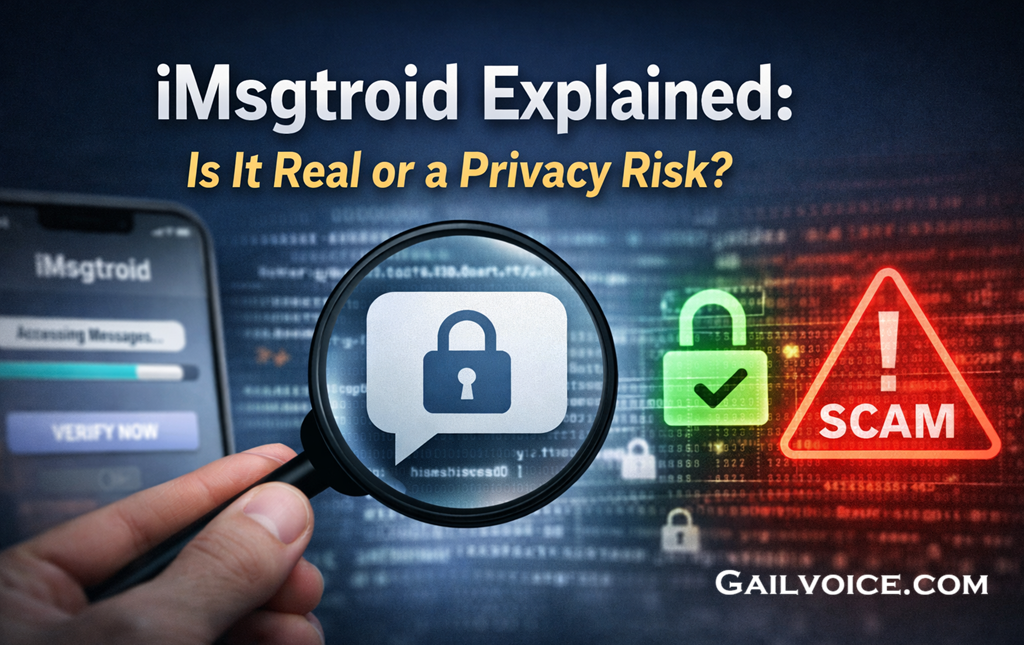
iMsgtroid is a website promoted on social media that claims to show private iMessage conversations using only a phone number, but it cannot technically access iMessage data and is widely considered unsafe.
Because iMessage uses end-to-end encryption controlled by Apple, no third-party website can view private messages without device access or valid account credentials.
This article explains what iMsgtroid claims to do, why those claims do not work, the real risks involved, and what safe alternatives actually exist.
In short, iMsgtroid does not show real iMessages and primarily exposes users to privacy and security risks.
Understanding iMsgtroid at a Basic Level
At first glance, iMsgtroid looks like a simple online tool. It promises something powerful and personal. The site suggests that private iMessages or call history can be revealed instantly by typing in a phone number.
That promise creates curiosity. It also creates confusion.
In reality, iMsgtroid does not function as a message viewer. It is not connected to Apple systems, user devices, or iCloud data. Instead, it relies on visual tricks and user interaction to keep visitors engaged.
Why iMsgtroid Feels Convincing to Many People
iMsgtroid succeeds because it understands how people think online.
It uses progress bars, scanning animations, and technical language that feels familiar but remains vague. These elements give the impression that something complex is happening in the background.
At the same time, social media videos often frame it as a hidden method or shortcut. When many people talk about the same thing, it feels credible. However, popularity does not equal legitimacy.
How iMessage Security Actually Works
To understand why iMsgtroid cannot work, it helps to understand how iMessage is designed.
iMessage uses end-to-end encryption. This means messages are locked on the sender’s device and unlocked only on the recipient’s device. Even Apple cannot read the content of iMessages in transit.
Access to messages requires one of the following:
-
Physical access to the device
-
The correct Apple ID and password
-
A verified iCloud backup owned by the user
A phone number alone provides none of these.
Because of this design, no third-party website can retrieve private iMessages remotely.
What iMsgtroid Actually Does When You Use It
When a user enters a phone number, iMsgtroid does not connect to any message database. Instead, it runs a scripted flow designed to look technical.
Usually, this includes:
-
A fake scanning or loading screen
-
Claims that data has been found
-
A required “human verification” step
The verification step is the core of the operation. Users are pushed to complete surveys, download apps, or click promotional links. These actions generate revenue for the site owners.
No real message content is ever shown.
Why iMsgtroid Is Considered Risky
Although it may seem harmless, iMsgtroid carries real risks.
First, users often submit personal details such as phone numbers or email addresses. This information can later be used for spam, phishing, or scams.
Second, some verification steps redirect users to unknown downloads or aggressive advertising pages. These can expose devices to malware or unwanted tracking.
Third, the site provides no transparency. There is no verified ownership, no technical explanation, and no proof of capability. This lack of accountability is a major warning sign.
Separating Verified Facts From Misleading Claims
Some online content describes iMsgtroid as a futuristic messaging platform or advanced AI system. These descriptions are not supported by evidence.
There is no verified app, software platform, or service called iMsgtroid that offers legitimate messaging, device integration, or AI features. These narratives often exist to attract clicks rather than to inform users.
The factual description is far simpler. iMsgtroid is a website built around a claim that cannot be technically fulfilled.
Legal and Ethical Boundaries Matter
Accessing someone else’s private messages without consent is illegal in many regions and unethical everywhere.
Privacy laws are designed to protect personal communication. Even attempting to bypass these protections can create legal and personal consequences.
Beyond legality, there is a human element. Private messages exist within trust. Any tool that promises silent access to them should be approached with skepticism.
Legitimate Ways to Access Your Own Messages
If the goal is practical rather than intrusive, safe options already exist.
You can manage or recover your own iMessages through:
-
iCloud message syncing
-
Encrypted device backups
-
Restoring data using official Apple tools
These methods respect privacy and security while giving users full control over their own data.
How to Stay Safe From iMsgtroid Style Sites
Digital safety does not require advanced knowledge. It requires awareness.
-
Avoid entering personal data on unverified sites
-
Be cautious of tools that promise instant access to private data
-
Keep devices updated with security protections
-
Question claims that bypass encryption or consent
When something sounds too easy, it usually is.
The Bigger Picture Behind iMsgtroid
iMsgtroid is not unique. It represents a broader pattern where curiosity meets misinformation.
As technology becomes more complex, some websites exploit that complexity. They rely on confusion rather than capability.
Understanding how systems work removes the illusion of secret access. Knowledge replaces fear and temptation with clarity.
Final Thoughts on iMsgtroid
iMsgtroid is best understood as a misleading website that uses curiosity-driven design rather than real technical access. It cannot view iMessages, it does not connect to Apple systems, and it exposes users to unnecessary risk.
If you are trying to manage your own messages, secure tools already exist. If a site claims it can reveal someone else’s private conversations instantly, the safest response is to leave.
True digital confidence comes from understanding how technology protects us, not from trying to bypass it.