
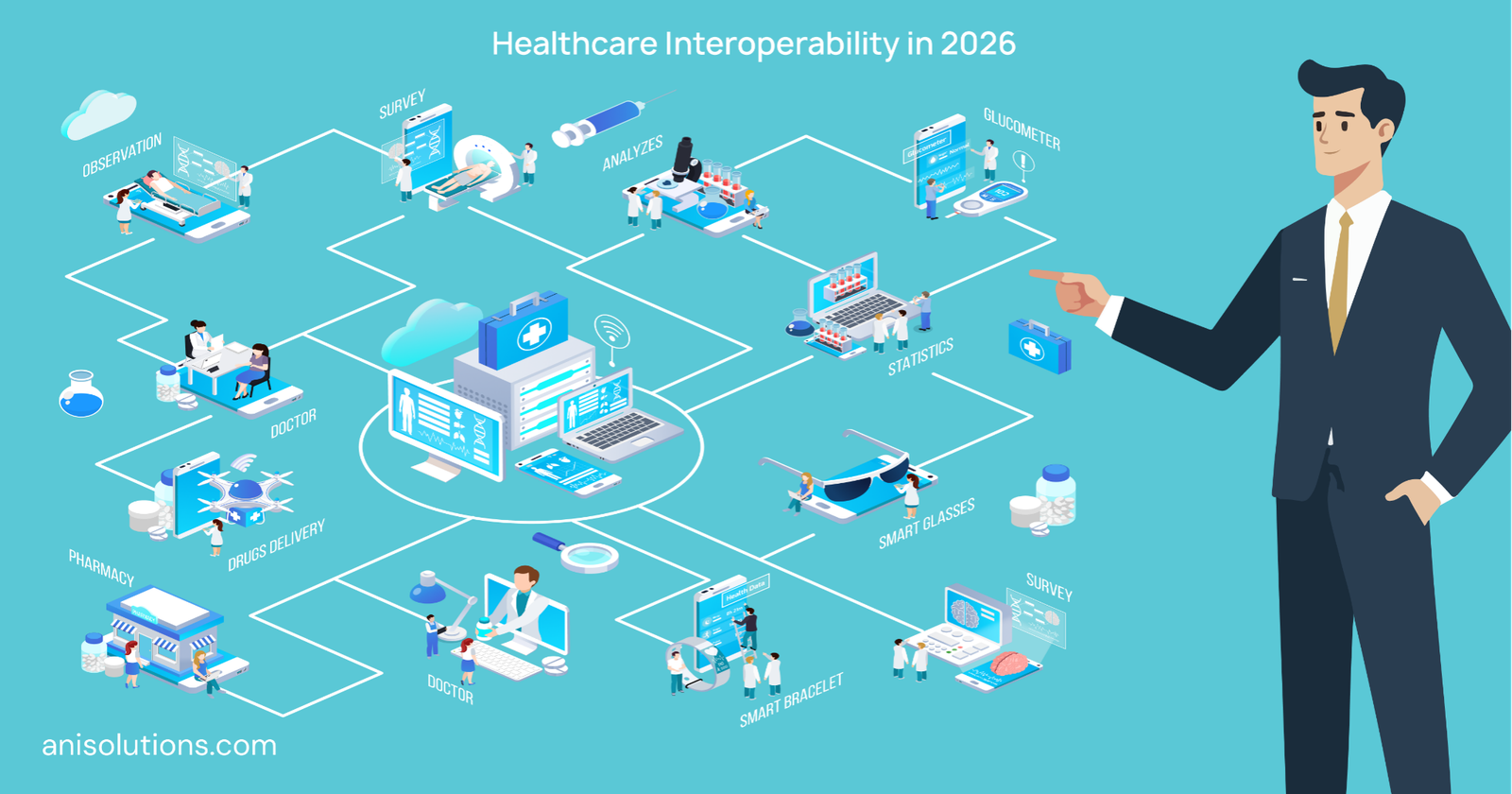
Right now, how seamlessly your information moves from one system to another system is becoming more important. And this shift happened with the pandemic, as the fax-era healthcare, where the patient data was fragmented and often moved slowly, ended.
With this, the data sharing shifted to real-time clinical data exchange. Moreover, as the regulatory requirements from CMS, ONC, and now the 21st Century Cures Act compliance are making it mandatory for the real-time availability and transperency.
This is why healthcare interoperability solutions are moving towards an API-first approach. And most importantly, it is shifting from just the IT department’s responsibility to boardroom decisions. As the interoperable systems are the foundation for future-growth, revenue generation, regulatory compliance, and long-term scalability.
That’s why, in this blog, we will understand how healthcare leaders are leveraging healthcare IT infrastructure and EHR integration services to build systems that are interoperable and not just connected.
Let’s dive in!
Why Interoperability Now Demands Executive Attention?
As said in the introduction, interoperability is no longer a technical upgrade. It’s a compliance, financial, and organizational risk if not done right. For healthcare leaders, not having interoperable systems impacts revenue, operations, and accountability.
The first pressure is financial, as healthcare is becoming value-based care. The reimbursement model depends on outcomes, care coordination, accurate data reporting, and real-time data availability.
However, if the systems are disconnected, they create gaps in data exchange, leading to incomplete patient records and inaccurate data, leading to lost revenue. These inconsistencies and data silos result in claim denials, reducing revenue generation.
At the same time, regulatory expectations are tightening. Mandates around the 21st Century Cures Act compliance, CMS interoperability rules, and ONC guidelines are forcing organizations to enable secure, standardized patient data portability. This isn’t optional anymore. Failure to comply doesn’t just slow operations; it exposes organizations to penalties, audits, and reputational risk.
And then there’s the growing issue of accountability.
When systems don’t communicate, responsibility becomes blurred. Care gaps go unnoticed, data discrepancies increase, and leadership teams are left without a reliable, unified view of performance. In today’s environment, that lack of visibility translates directly into operational risk.
This is why healthcare interoperability solutions are now being discussed at the executive level. They are no longer just about connecting systems like EHRs, labs, and billing platforms through EHR integration services—they are about creating a transparent, compliant, and financially resilient healthcare IT infrastructure.
The Business Cost of Disconnected Systems
The disconnected systems not just drain revenue but also slow down care delivery and increase clinical risks. For instance, when the data of a lab test does not update in the patient record, they have to repeat the same tests again with a new healthcare provider.
This not only increases cost but also forces patients into repeated loops and unnecessary procedures again and again, reducing trust and ruining the care experience. However, one deeper issue of siloed data exchange is the slowing down of daily workflows.
Without efficient clinical data exchange, clinicians need to navigate fragmented systems, manually reconcile information, and rely on incomplete information. This slows down decision-making and significantly contributes to clinician burnout.
After this comes the impact on patient outcomes. When critical information is delayed or missing, care decisions are made without accurate data. This leads to treatment delays, care gaps, and higher readmission rates, especially in complex or chronic cases. In a value-based care environment, these gaps directly affect both patient outcomes and reimbursement.
Finally, the most underestimated cost is revenue leakage. As disconnected systems break the flow of data, creating breakdowns across billing, coding, and documentation workflows. Missing or inconsistent data leads to client denials, undercoding, and compliance risks. Over time, this leads to significant financial losses, often without organizations fully realizing where the gaps are coming from.
This is exactly where healthcare interoperability solutions improve patient data portability. They enable seamless data flow with HL7 FHIR standards and robust EHR integration services, eliminating redundancies, streamlining workflows, and closing revenue gaps.
The Rise of Interoperability as Competitive Advantage
For years, healthcare organizations viewed interoperability as just a technical requirement, but today it is becoming a key competitive advantage to have. In modern healthcare, patients want convinience in accessing their data and receiving care.
And without true interoperability, providing seamless data access and connected care is almost impossible. That’s why the organizations that are able to build interoperable ecosystems are pulling ahead from those that rely only on integration.
Next comes the adoption of digital health with telehealth, RPM, and app-based care models. All these technologies depend on continuous, reliable clinical data exchange. Without robust interoperability foundations, these initiatives remain fragmented and underutilized. But with the right healthcare interoperability solutions, organizations can easily create seamless data channels, achieving all requirements.
And perhaps the biggest shift is happening in decision-making as healthcare leaders are no longer operating on incomplete data. With connected ecosystems and standardized data flows enabled by frameworks like HL7 FHIR standards and supported through Health Information Exchange (HIE) networks.
Now, organizations can gain real-time, actionable insights, allowing them to make faster and more accurate clinical decisions. In short, interoperability is no longer just about making systems work together. It’s about making it work smarter, faster, and more responsive.
How Modern Healthcare Interoperability Solutions Enable This Shift?
Modern healthcare interoperability solutions are not built on a single tool or platform; they rely on a combination of technologies that work together. These technologies enable seamless, real-time clinical data exchange across systems.
From connecting EHRs and labs to integrating billing and third-party applications, the goal is simple: to create a unified and scalable healthcare IT infrastructure.
Here’s a simplified view of the key components enabling this shift:
| Component | What It Does | Business Impact |
| APIs | Enable real-time communication between systems | Faster integrations and reduced manual effort |
| HL7 FHIR standards | Standardize how healthcare data is structured and shared | Scalable, future-ready interoperability |
| EHR integration services | Connect clinical, billing, and external systems | Streamlined workflows and better care coordination |
| Health Information Exchange (HIE) | Enables secure data sharing across organizations | Improved collaboration and patient outcomes |
| Integration platforms | Bridge legacy and modern systems | Maximizes existing investments while enabling innovation |
Together, these components power standardized, real-time patient data portability, helping healthcare organizations move from a fragmented to a connected, future-ready ecosystem.
What Healthcare Leaders Should Do Next?
As interoperability becomes central to financial performance, compliance, and care delivery, healthcare leaders need to move from fragmented initiatives to a clear, long-term strategy.
The first step is to define an interoperability roadmap aligned with organizational goals—whether that’s improving value-based care performance, reducing claim denials, or enabling better patient engagement. Without a defined direction, integration efforts often remain reactive and short-lived.
Equally important is choosing the right foundation. Investing in standards-based architecture built on HL7 FHIR standards and scalable APIs ensures that systems can evolve without constant rework. This is critical for supporting future requirements around patient data portability, regulatory compliance, and expanding digital health initiatives.
Leaders should also evaluate the role of experienced EHR integration services partners. Interoperability is not just about technology—it requires a deep understanding of workflows, compliance frameworks, and system dependencies. The right partner can accelerate implementation while minimizing disruption.
Finally, the focus must shift from short-term fixes to long-term ROI. Point-to-point integrations may solve immediate problems, but they often create complexity over time. A strategic, platform-driven approach to healthcare interoperability solutions delivers sustained value—both operationally and financially.
The organizations that get this right won’t just improve connectivity—they’ll build a resilient, scalable healthcare IT infrastructure ready for what’s next.
End Thoughts
In a nutshell, interoperability has become essential as it is becoming the foundation for future growth, revenue protection, compliance, security, and patient retention. Without an interoperable ecosystem healthcare organization may not be able to keep up with the evolving healthcare landscape.
And this is why building interoperability has gone from just an IT department’s responsibility to a board-level decision-making. So, in 2026, early adopters will gain a significant competitive advantage over the late-runners.
If you are interested in turning your healthcare IT infrastructure interoperable, then talk to our EHR integration experts and assess your systems right away.
Frequently Asked Questions
- What are the core components of modern healthcare interoperability solutions?
Modern healthcare interoperability solutions rely on APIs, HL7 FHIR standards, EHR integration services, Health Information Exchanges (HIEs), and middleware platforms. Together, these enable secure, real-time clinical data exchange, standardization, and seamless connectivity across EHRs, labs, billing systems, and third-party applications within a scalable healthcare IT infrastructure.
- How does the 21st Century Cures Act impact hospital board decisions in 2024?
The 21st Century Cures Act pushes hospital boards to prioritize interoperability, patient data access, and compliance. It mandates patient data portability and penalizes information blocking, forcing leadership to invest in standards-based systems, strengthen governance, and align technology decisions with regulatory, financial, and reputational risk considerations.
- Why is FHIR considered the gold standard for EHR integration?
FHIR is considered the gold standard because it enables standardized, API-based data exchange using modern web technologies. It simplifies integration, supports real-time access, and improves scalability compared to legacy HL7 formats. This makes EHR integration faster, more flexible, and better aligned with evolving interoperability and patient access requirements.
- What are the biggest barriers to achieving full semantic interoperability in US healthcare?
Key barriers include inconsistent data standards, lack of unified clinical terminology, legacy system limitations, and fragmented data governance. Variations in coding systems and incomplete adoption of standards like FHIR hinder accurate data interpretation, making it difficult to achieve true semantic interoperability across diverse healthcare systems.
- How do interoperability solutions directly reduce physician burnout and “click fatigue”?
Interoperability solutions reduce burnout by minimizing manual data entry, eliminating redundant workflows, and providing unified patient records across systems. With seamless clinical data exchange, physicians spend less time navigating multiple platforms and more time on patient care, significantly reducing administrative burden and “click fatigue.”
- What is the difference between technical, syntactic, and semantic interoperability?
Technical interoperability enables systems to connect and transmit data. Syntactic interoperability ensures data follows standardized formats like HL7 or FHIR. Semantic interoperability goes further by ensuring shared understanding of data meaning, enabling accurate interpretation and use across systems for effective clinical decision-making.